Recalling Shakespeare’s seven ages of man (in As You Like It, II, vii), at almost 75 I find myself entering upon the sixth stage—“the lean and slippered pantaloon.” And like all the elderly, I’ve started to ask some serious questions.

Such as: What’s wrong with me? Why is my energy diminishing? Why am I always tired? Why can’t I sleep well? Why is my whole frame stiffening up? Why am I falling apart? What’s going on here? How could I have let myself go like this? And so on.
There is, of course, a simple answer to these questions: I’m dying. Not tomorrow, maybe, or even next year, perhaps. But dying I am, slowly, inexorably, assuredly. Being a sinner, little by little I am receiving the wages of sin, which is death. Yet thankfully, as a Christian, “though outwardly I am wasting away, yet inwardly I am being renewed day by day” (2 Cor 4:16).
Nevertheless, outwardly I am wasting away, and this process will end in Shakespeare’s seventh and final stage: “last scene of all … childishness and mere oblivion.” And then the curtain.
The hardest thing about growing old, I think, is shame. As I watch my beloved castle crumbling, amidst all the difficulties and losses and diminishments I cannot help asking, not just What’s wrong with me?, but Whose fault is this? Is it God’s? Is He the one making me suffer? Or can the fault be placed, perhaps, on this corrupt society in which I live, this dying civilization?
Such buck-passing will take me only so far. Sooner or later it comes down to me. I am the one responsible for this utter debacle, this eventual total failure of all my systems. I may not be quite sure exactly what I’ve done to deserve this implacable judgment. Yet deep down, I’ve read the writing on the wall: Mene mene tekel upharsin. That is, I’ve been weighed in the scales and found wanting. My tragic fate is entirely my own fault. It is I, I alone, who have brought down my own house upon myself.
Naturally I may have excellent mechanisms for refusing to acknowledge my responsibility. So much the worse for me, because then the shame of my deplorable condition eats away not only at my outsides but at my insides. Whether unconsciously, semi-consciously, or in the full light of day, one simple fact will eventually have its way with me: I am doomed to destruction.
Oh dear … this blog post has gotten awfully heavy, hasn’t it? Yes, and old age will weigh heavily on you, too, when you get there, and as your failures and forfeitures accumulate, you will wonder what on earth has gone wrong. Can’t you send this dilapidated mechanism back to the manufacturer?
Actually, yes you can. But first you must answer a tough question, namely: Have you really been so bad as to deserve this calamity?
Yes, you have. You are a sinner, and sin really is that bad. You have gorged yourself on the pride of life, and now it is time to eat the pie of humility. The shame you feel is fully justified, for “all have sinned and fallen short of the glory of God” (Rom 3:23).
Fortunately there is an answer to this dire predicament. Amidst all the bad news, there is good news, and that is the gospel of Jesus Christ.
The gospel will not keep your body from deteriorating and dying. But it will, if you let it, entirely relieve you of guilt and shame. In fact this is exactly what the gospel is tailor-made to do. For “there is now no condemnation for those who are in Christ Jesus” (Rom 8:1). The gospel is designed to set you free—completely!—from worry and oppression and to replace your negative thoughts (which only increase the burden of age) with peace and joy.
The gospel is simple: Admit you’re a sinner, repent, and place all your faith in Jesus Christ. After that, you can quit shaming and blaming yourself or anyone else (including God) for all that’s wrong. Let Jesus take the blame, which He did on the cross. Granted, you too must deny yourself and take up your cross (Mt 16:24). The hard part of this statement is the first half: deny yourself. Do this and the rest is easy. In fact, when you stumble Jesus will come alongside, like Simon of Cyrene, and lift the burden from you.
In the words of Tim Keller, “The gospel is this: We are more sinful and flawed in ourselves than we ever dared believe, yet at the same time we are more loved and accepted in Jesus Christ than we ever dared hope.”
Knowing the gospel is like having your own personal counselor to relieve you of guilt and shame, plus a private physician to minister to all the ailments of your advancing years. And there’s more: When you believe in Jesus, though your body will die, you yourself will not, and one day you will be reunited with your resurrected body and the two of you—now finally one—will live forever.
It’s a good deal. Sign up today, and throw off your slippers and dance in your pantaloons. Take to heart the words of the poet Yeats in “Sailing to Byzantium”:
An aged man is but a paltry thing,
A tattered coat upon a stick, unless
Soul clap its hands and sing, and louder sing
For every tatter in its mortal dress.
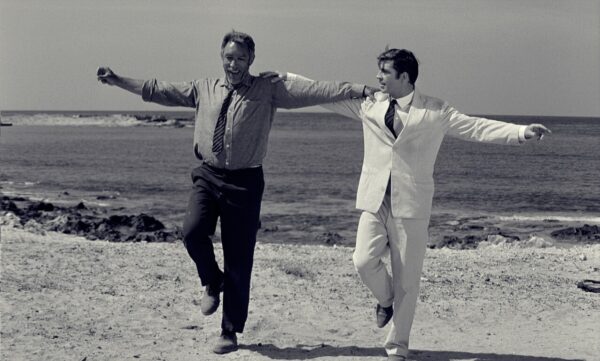
Anthony Quinn & Alan Bates dancing on the beach in the film “Zorba the Greek”