Looking for a spectacular Christmas present? Or how about an ordinary one: my most recent book, Same Old, Same New: The Consolation of the Ordinary. Here’s a sample chapter.
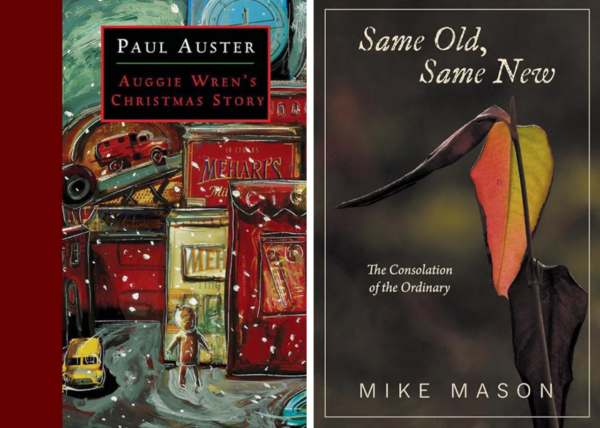
Paul Auster, in Auggie Wren’s Christmas Story, tells of a character with an unusual hobby (a scene which, incidentally, featured in the movie Smoke):
He opened a cardboard box and pulled out twelve identical black photo albums. This was his life’s work, he said, and it didn’t take him more than five minutes a day to do it. Every morning for the past twelve years, he had stood at the corner of Atlantic Avenue and Clinton Street at precisely seven o’clock and had taken a single color photograph of precisely the same view. The project now ran to more than four thousand photographs. Each album represented a different year, and all the pictures were laid out in sequence, from January 1 to December 31, with the dates carefully recorded under each one.
As the narrator of Auster’s story pores over these photos—at first glance all the same—gradually he finds himself turning the pages more and more slowly. “I paid closer attention to details, took note of shifts in the weather, watched for the changing angles of light as the seasons advanced.” He is noticing subtle differences. He is noticing, period. With the result that “I was no longer bored, no longer puzzled as I had been at first.”
Photographer Freeman Patterson used to give his students the exercise of standing in one place—say, at an open window—and taking thirty photographs. After a dozen or so exposures, he said, you begin to feel bored, and by about eighteen you’re in purgatory. But around about twenty-one something different starts to happen. You begin to see new and fascinating possibilities that you didn’t know were there. You’re becoming enthralled with the ordinary.
What Patterson wanted to teach his students was that any aspect of the world, however humble or minute, is infinitely contemplable. Isn’t that why scientists are able to devote an entire career to the study of nematodes or indehiscence? Isn’t it also why some people are quite content living in the same place all their lives? Rachel Denton, an English hermit, describes her life as “one of becoming ever more sensitive to God-in-this-place.” The commonest things are like stained glass windows: dull and uninteresting when dark, but when illumined—how glorious!
Some people’s lives are so ordinary that they feel they have no purpose, that life is meaningless. As we turn the pages of our own ‘boring’ lives more slowly, more deliberately, perhaps we too can shed our jadedness and become absorbed. Standing at our own little corner, looking out at the same scene every day, we may see that it is not the same at all, or else the fact that it is the same will no longer be boring.
My book, Same Old, Same New: The Consolation of the Ordinary, is like those photo albums in Auggie Wren’s Christmas Story: one single subject, reiterated over and over in slightly different ways. Because this is our world. This is life, how it is: a densely woven multiplicity of everyday realities, all different, all unique, but all essentially bearing the same message, all saying the same thing. And so this is an ordinary book. Don’t expect too much from it. On the other hand, expect everything. Because this is all there is.
Next Post: Everything at Once: My New Christmas Story!